 +964 750 481 3436
 Rasty New, Near Zanko Bank, Erbil – Iraq
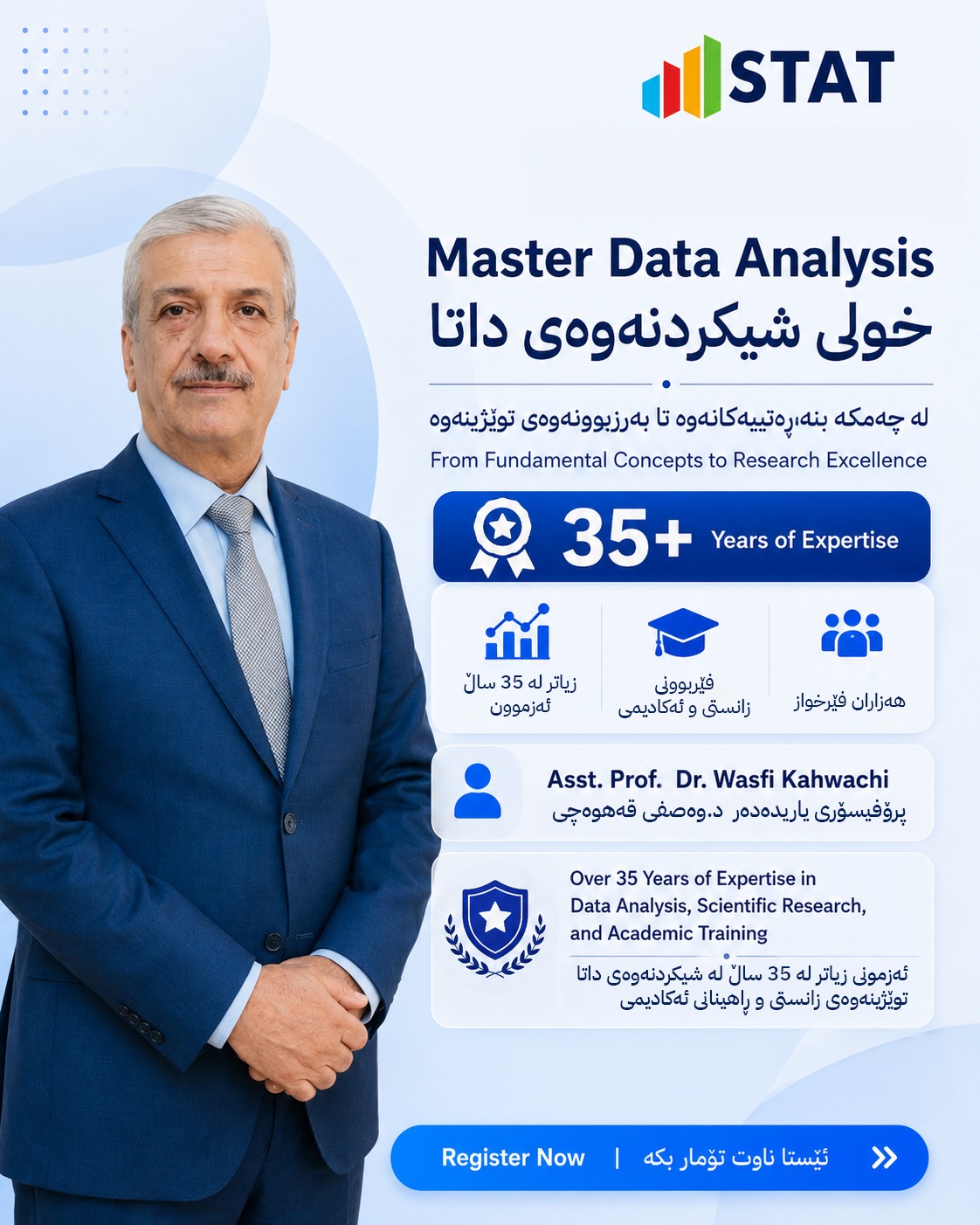
Master Data Analysis: From Fundamental Concepts to Research Excellence
Course Overview
Master Data Analysis: From Fundamental Concepts to Research Excellence is an intensive, application-oriented training course designed to develop participants’ competence in statistical thinking, data management, analysis, interpretation, and research reporting using IBM SPSS Statistics.
The course begins with fundamental statistical concepts and gradually progresses toward practical data analysis techniques commonly required in academic research, surveys, evaluations, and applied studies. Participants will learn not only how to perform statistical analyses in SPSS, but also when, why, and how to select appropriate statistical methods, assess their assumptions, interpret statistical outputs, and communicate findings effectively.
Through a combination of concise theoretical explanations, practical demonstrations, real research examples, and hands-on exercises, participants will develop the confidence and skills required to transform raw data into meaningful and scientifically interpretable results.
Course Objectives
By the end of the course, participants will be able to:
- Understand fundamental concepts of statistics and research data analysis.
- Distinguish between populations and samples and understand basic sampling concepts.
- Identify different types of variables and levels of measurement.
- Design and organize research databases in SPSS.
- Enter, code, clean, manage, and transform research data.
- Select appropriate statistical techniques based on research questions and data characteristics.
- Conduct and interpret descriptive and inferential statistical analyses.
- Produce appropriate tables, graphs, and statistical summaries.
- Assess key assumptions underlying statistical procedures.
- Conduct correlation, regression, and group-comparison analyses.
- Interpret SPSS output accurately and present findings in an academic format.
- Develop a systematic data-analysis plan for research projects, surveys, and evaluation studies.
- Apply statistical methods with greater confidence in academic and professional research.
Key Topics
By the end of the course, participants will be able to:
1. Foundations of Data Analysis
- Introduction to statistics and data analysis
- Population, sample, and sampling
- Types of data and variables
- Levels of measurement
- Independent and dependent variables
- Descriptive and inferential statistics
- Statistical hypotheses and significance
2. Research Data Management Using SPSS
- Introduction to the SPSS environment
- Creating and structuring a research database
- Variable definition and coding
- Data entry and data screening
- Importing and exporting datasets
- Selecting and sorting cases
- Recoding and computing variables
- Merging datasets
- Identifying and managing missing data
- Data transformation and preparation
3. Descriptive Data Analysis
- Frequencies and percentages
- Measures of central tendency
- Measures of dispersion
- Cross-tabulation
- Tables and charts
- Bar charts, pie charts, histograms, and boxplots
- Exploring distributions and normality
- Presenting descriptive findings effectively
4. Relationships Between Variables
- Introduction to correlation analysis
- Pearson correlation
- Assumptions of correlation
- Interpretation of correlation coefficients
- Scatterplots and graphical assessment
- Simple linear regression
- Multiple linear regression
- Interpretation of regression results
5. Analysis of Categorical Data
- Cross-tabulation
- Row and column percentages
- Chi-square test of independence
- Testing relationships between categorical variables
- Interpretation and presentation of categorical-data results
6. Hypothesis Testing and Mean Comparisons
- Sampling distributions
- Standard deviation and standard error
- One-Sample t-test
- Independent-Samples t-test
- Paired-Samples t-test
- Comparing groups and evaluating change over time
- Statistical significance and interpretation
7. Communicating Statistical Results
- Reading and interpreting SPSS output
- Modifying statistical tables and charts
- Creating publication-ready tables and figures
- Exporting results to Microsoft Word and Excel
- Reporting statistical findings in academic research
- Avoiding common mistakes in statistical interpretation
Who Should Attend?
This course is suitable for:
- University students and postgraduate researchers
- Academic researchers and lecturers
- Professionals conducting surveys and evaluations
- Research assistants and data analysts
- Governmental, NGO, and INGO staff working with data
- Anyone who wants to develop practical SPSS and research data-analysis skills
- Beginners with limited or no previous experience in SPSS
Course Details
- Special Discount for Bachelor’s Students (20%)!
- The course is delivered in both online and face-to-face formats, with both options covering the same core content, practical activities, and learning objectives.
- Duration: 4 Days
- Date: 16, 17, 18, & 19 August 2026
- Time: 4:00 PM – 6:00 PM
- Class Capacity: 15–18 Participants
- Certificate: A special course certificate will be provided upon successful completion.
Prerequisites
- No advanced statistical or SPSS background is required. The course starts from the fundamental concepts and progressively develops practical analytical skills.
- Participants should bring a laptop for hands-on practice.
Trainer
Asst. Prof. Dr. Wasfi Kahwachi
35+ Years of Experience in Data Analysis, Research Training & Statistical Consultancy